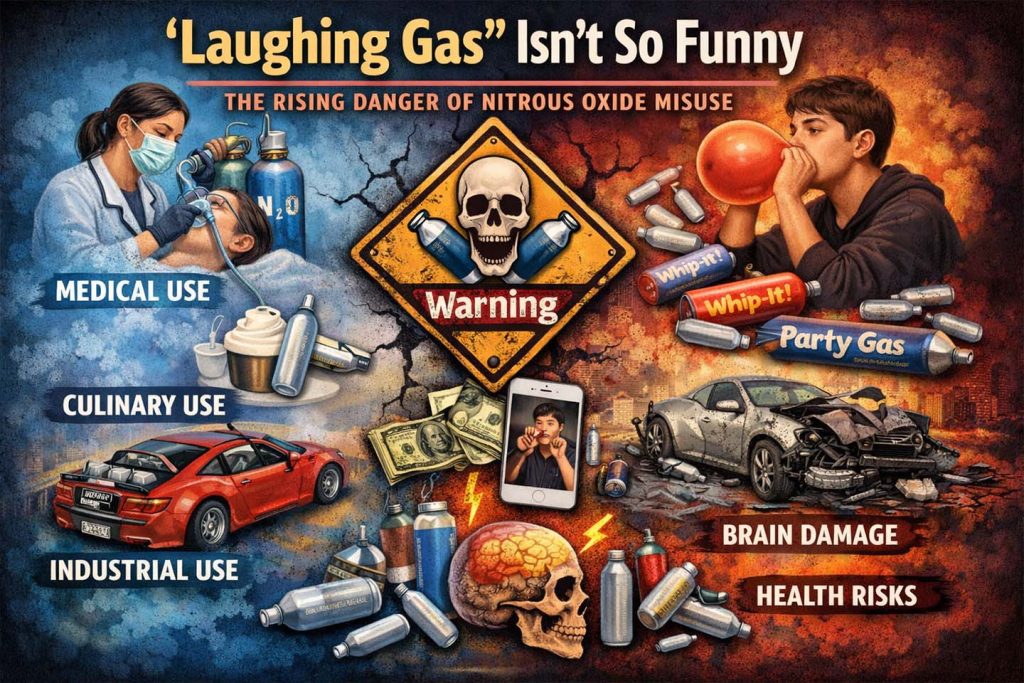
The Rising Danger of Nitrous Oxide Misuse
Nitrous oxide (N₂O), often called laughing gas, has a long track record of legitimate uses in medicine and industry — but its recreational misuse has become a dangerous public health issue across the United States. Originally intended for dental anesthesia and culinary purposes, nitrous is increasingly inhaled by teens and young adults for short-lived euphoric effects, with potentially devastating consequences for both users and the community at large.
What Nitrous Oxide Is — and What It Should Be Used For
Chemically, nitrous oxide is a colorless, sweet-smelling gas. It serves several important legitimate roles:
- Medical/Anesthetic Use: Administered by trained professionals to relieve pain and anxiety during dental procedures, childbirth, and minor surgery. In medical settings it’s delivered with oxygen and closely monitored.
- Culinary Use: Food-grade nitrous oxide acts as a propellant in whipped-cream chargers and similar culinary tools. These chargers pressurize cream to whip it, and food establishments use N₂O cartridges for texture and aeration.
- Industrial Applications: N₂O can also appear in automotive systems and some industrial processes.
These uses are responsible and regulated — but problems arise when the same gas is repurposed for inhalation.
From Whipped Cream to Whippets — The Misuse Problem
When inhaled intentionally to achieve a “high,” nitrous oxide acts on the brain in ways that can be harmful:
- Short-term effects include euphoria, dissociation, dizziness, and impaired motor control — posing serious safety risks.
- Health dangers include oxygen deprivation, dangerously low blood pressure, loss of consciousness and even death.
- Long-term misuse may contribute to neurological damage, vitamin B12 deficiency, nerve injury and psychiatric symptoms.
Often called whippets, whip-its or hippie crack, these nitrous canisters have become increasingly marketed — explicitly or by design — toward recreational users: larger volumes, brightly colored packaging and fruity “flavors” make them more attractive to teens and young adults.
** Availability + Marketing = A Public Health Threat**
A major factor in the rising misuse of nitrous oxide is how widely accessible it has become:
- Smoke and vape shops, convenience stores and even some online retailers stock nitrous cartridges and larger tanks — often sold under food-use labels such as “Galaxy Gas,” “Cosmic Gas” and others.
- These products are often marketed as culinary tools, but their size, branding and placement in shops that sell substances associated with recreational use create a loophole that facilitates abuse.
- Social media trends have amplified use, showing people inhaling from balloons or cartridges for a quick high, further normalizing what can be a dangerous practice.
Because there are no federal age or purchase limits on most nitrous oxide products sold for non-medical purposes, many retailers don’t restrict access — and young people can buy large quantities with ease.
Real World Consequences: Accidents, Injury, and Legal Liability
Recreational nitrous misuse doesn’t just affect individuals’ health — it can lead to accidents that harm others. Drivers impaired by nitrous have been involved in fatal crashes, and emergency responders nationwide are reporting increases in collapses, loss of consciousness and other acute events tied to inhalation misuse.
Significant legal actions against manufacturers and distributors underscore this danger. In a landmark 2023 case, a Missouri jury awarded $745 million against United Brands and a retailer for conspiring to market nitrous oxide in ways that contributed to a fatal accident, holding the companies liable for downplaying risks and enabling its recreational use.
Across the country, class-action lawsuits allege that some brands and retailers knowingly sold oversized flavored nitrous canisters destined for abuse, seeking financial compensation and changes in how these products are marketed and sold.
Orange County Takes Action: Bans and Local Enforcement
Recognizing the severity of the issue locally, Orange County has taken ground-breaking steps:
- In February 2025, the Orange County Board of Supervisors — led by Vice Chair Katrina Foley — unanimously passed an ordinance banning the retail sale of nitrous oxide for recreational use in unincorporated areas of the county.
- This law makes selling nitrous oxide for inhalation a misdemeanor subject to fines or jail time and directs county agencies to survey health professionals and law enforcement to better understand local misuse.
- Cities within Orange County, such as Newport Beach, have followed suit, passing similar bans and aligning local policies with the county’s approach.
- Foley’s office has also shared model ordinances with other municipalities and spearheaded public education campaigns to raise awareness about hazards associated with nitrous abuse.
These actions address the loopholes exploited by retailers — where shops could sell nitrous as a “culinary propellant” while implicitly allowing its recreational misuse — by making recreational sales illegal and empowering residents to report violations.
Broader Efforts and the Road Ahead
While local action in Orange County is a critical step, nitrous oxide misuse remains a challenge nationally. Recent warnings from the U.S. Food and Drug Administration highlight the health risks associated with recreational inhalation, including hospitalization and death, and call on retailers to reconsider how these products are marketed and sold.
State-level responses are also growing. Some states have moved to classify devices designed for recreational inhalation as drug paraphernalia or restrict sales to minors, although enforcement varies widely and loopholes remain.
Conclusion: A Balanced but Urgent Call for Change
Nitrous oxide will continue to play a legitimate role in medical and culinary settings — but its misuse as an inhalant poses serious risks to individual and public safety. The ease with which it can be bought and the way it’s marketed in smoke shops and similar venues have created a public health problem that cannot be ignored.
With bold local policies like those championed by Katrina Foley in Orange County, increasing legal accountability for manufacturers and distributors, and growing public awareness, communities can begin to turn the tide on nitrous abuse — protecting young people and making clear that a substance’s availability should never outweigh safety.