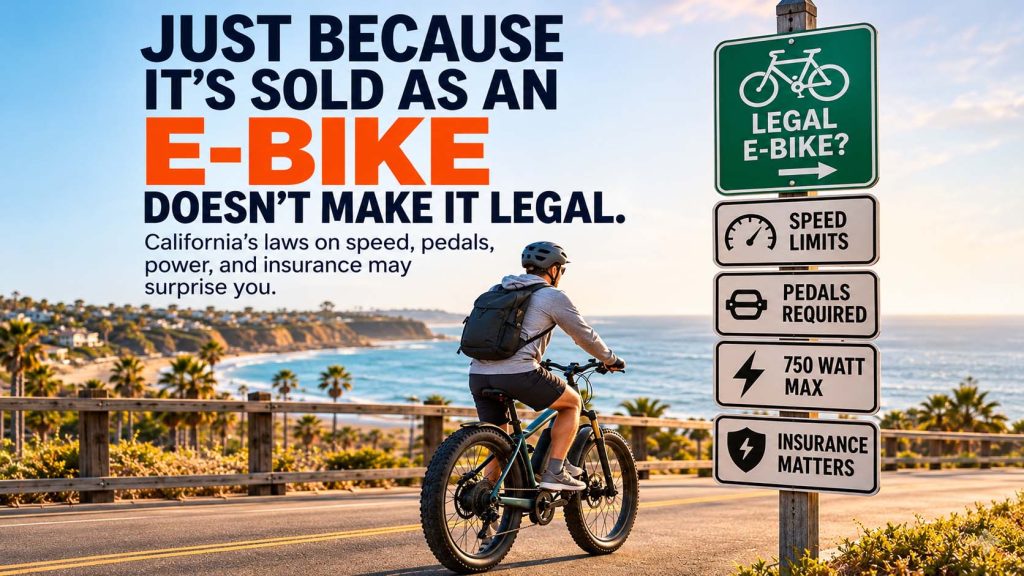
California E-Bike Laws: What's Legal and What's Not
California’s laws on speed, pedals, power, and insurance may surprise you.
Electric bicycles have exploded in popularity throughout California, particularly in Orange County, where they have become a common sight on neighborhood streets, bike paths, and routes to school. But not every electric-powered bicycle is a legal e-bike under California law. Some high-powered vehicles marketed as e-bikes are legally closer to motorcycles, with significant consequences for safety, licensing, liability, and insurance.
What Qualifies as a Legal E-Bike in California?
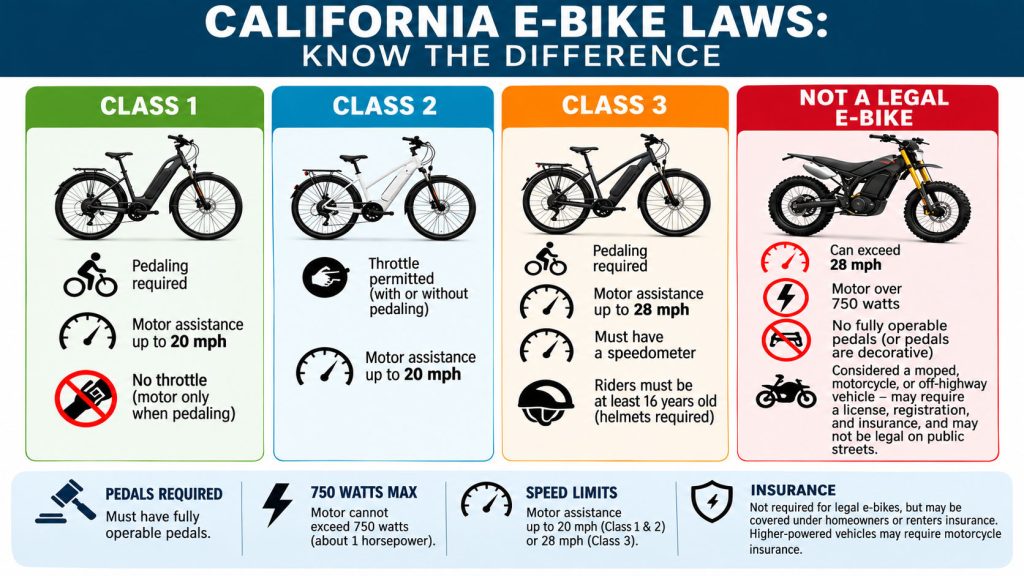
California Vehicle Code section 312.5 requires fully operable pedals and an electric motor of no more than 750 watts. California recognizes three classes of electric bicycles:
Class | Motor assistance | Assisted speed limit |
Class 1 | Pedaling required | 20 mph |
Class 2 | Throttle permitted | 20 mph |
Class 3 | Pedaling required | 28 mph |
Class 3 e-bikes must have a speedometer. These limits govern motor assistance, not every possible downhill or pedal-powered speed. Limited low-speed start or walk assistance is permitted under statutory conditions.
When Does an E-Bike Become an Electric Motorcycle?
A vehicle with a throttle capable of propelling it to 35 or 40 mph without pedaling is not a legal Class 2 e-bike. Likewise, a vehicle with a motor exceeding 750 watts does not qualify simply because its rider selects a slower “eco” mode. The vehicle’s design, capabilities, and modifications matter—not just its speed at the time of a collision. A manufacturer’s label or marketing description cannot override California law.
What Happens If Your E-Bike Is Not Legally an E-Bike?
Depending on its specifications, the vehicle may be classified as a moped, motor-driven cycle, motorcycle, or off-highway electric motorcycle. That can mean licensing, registration or identification, helmet and equipment requirements, restrictions on public-road use, and different insurance obligations. Some vehicles cannot legally operate on public streets at all.
What About Children Riding E-Bikes?
California generally does not set a statewide minimum age for Class 1 or Class 2 e-bikes, but Class 3 riders must be at least 16. All Class 3 riders must wear helmets; riders under 18 must wear helmets on all three classes. Parents should not assume that a high-powered electric motorcycle is legal for a teenager merely because it resembles a bicycle. Higher speeds also mean greater collision forces and potentially devastating injuries..
Does California Require E-Bikes to Be Insured?
California does not require automobile liability insurance for a properly classified Class 1, 2, or 3 electric bicycle. But an uninsured rider may still face substantial personal liability after injuring a pedestrian, cyclist, or motorist.
Will Homeowners or Renters Insurance Cover an E-Bike Accident?
Possibly. Some policies cover certain bicycle-related personal liability claims, but motor-vehicle exclusions and other policy terms can limit coverage. The vehicle’s actual classification, motor power, throttle, and use may matter. Ask your insurance agent whether your specific model is covered, and obtain the answer in writing.
What About Automobile or Motorcycle Insurance?
An automobile policy generally does not automatically insure an e-bike. A street-legal motorcycle ordinarily requires appropriate motor vehicle coverage. Mopeds are subject to different rules, and California does not require insurance simply to register a qualifying moped. Specialty e-bike policies may offer liability, theft, and physical damage coverage, subject to their terms.
What If You’re Injured in an E-Bike Accident?
An injury investigation may require determining the vehicle’s true legal classification, the rider’s licensing obligations, whether it was permitted on the roadway or path, whether negligent entrustment or product defects contributed, and which insurance policies apply. Preserve the bicycle, controller settings, operating modes, manufacturer specifications, modifications, and labeling. A statutory violation may support a negligence claim, but it does not automatically establish liability; causation and the other legal requirements still matter.
Before You Buy or Ride, Know What You’re Getting
Check the motor wattage, assisted speed, throttle, pedal functionality, and manufacturer’s classification label. Electric bicycles can be a convenient and enjoyable alternative to driving, but consumers should understand what they are purchasing—especially for children. Just because a vehicle has two wheels, handlebars, and pedals does not mean California considers it a bicycle.
Traut Injury Law represents individuals and families injured in bicycle, e-bike, motorcycle, pedestrian, and other serious transportation accidents throughout Orange County and Southern California.