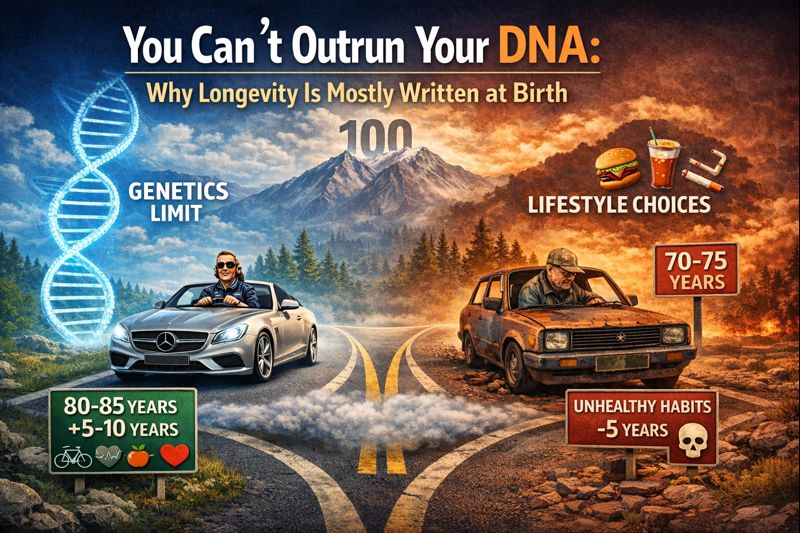
Why Longevity Is Mostly Written at Birth
We’ve all heard the promise: eat clean, exercise daily, avoid bad habits, and you can live well into your 90s—or even hit 100. A new study published in Science delivers a more sobering (and realistic) message: your genes set the ceiling on how long you can live, and lifestyle mostly determines how close you get to it.
Genes Set the Limit, Lifestyle Adjusts the Margin
Researchers analyzed decades of data from Swedish and Danish twins—including twins raised apart—along with American families that produced multiple centenarians. Their goal was to separate deaths caused by random or external factors (accidents, infections) from deaths tied to the biological aging process.
The conclusion was striking: genetics account for more than 50% of the differences in how long people live, far higher than earlier estimates. Lifestyle matters, but mostly at the margins—adding or subtracting a handful of years rather than decades.
Put simply:
- If your genetic potential is around 80, perfect habits might push you to 85
- Poor habits could pull you down to 75
- But no amount of kale or cardio is likely to turn an 80-year genetic profile into 100
Why Earlier Studies Got It Wrong
Previous research underestimated the role of genetics because it included people who died young from causes unrelated to aging—car accidents, infections, or early illness. When those deaths were removed, genetics emerged as the dominant factor in longevity.
The researchers likened it to vehicles: some people are born with a Mercedes, others with a Yugo. Maintenance matters—but it won’t turn one into the other.
Not All Diseases Are Equally Genetic
The study also found that genetics play different roles depending on the cause of death:
- Dementia showed the strongest genetic influence
- Cancer showed the weakest
This helps explain why some people live long lives only to face cognitive decline, while others develop cancer despite healthy lifestyles.
So… Does Lifestyle Still Matter?
Absolutely—just not in the way wellness culture often promises.
Healthy habits:
- Improve quality of life
- Reduce suffering and disability
- Can extend life by 5–10 meaningful years
For example, large observational studies show that a healthy 50-year-old woman might live into her early 90s, while an unhealthy peer might die in her late 70s. That’s not trivial. But when it comes to reaching extreme old age—well into the 90s or beyond—genes become the gatekeepers.
The Bottom Line
You can’t hack your way past your genetic ceiling—but you can decide whether you crash early or age well.
Or as one expert put it:
It’s easy to shorten your life. It’s very hard to lengthen it.
So take care of the body you were given. Just don’t blame yourself if it doesn’t last forever.