Let’s begin with the facts.
In the 2024 presidential election, Americans cast more than 158 million ballots, according to the United States Election Assistance Commission.
The agency also reported that more than 98% of election jurisdictions used voting equipment that either marked paper ballots or produced auditable paper records.
And following the 2024 election, the federal Cybersecurity and Infrastructure Security Agency reported finding no evidence of malicious activity that materially affected the security or integrity of the nation’s election infrastructure.
These are not the characteristics of an election system operating without safeguards. They are evidence of a massive, decentralized election process supported by verification, documentation, and auditing.
Of course, no system involving millions of people is perfect. Mistakes occur. Occasionally, people commit fraud. But isolated wrongdoing is not the same as a coordinated effort to manipulate an election.
The distinction is enormously important.
The Brennan Center for Justice at New York University School of Law examined elections that had been carefully studied for voter impersonation fraud.
Its research found incident rates ranging from just 0.0003% to 0.0025%.
That is approximately 3 to 25 incidents per million votes in the elections studied.
Importantly, those figures concern voter impersonation, not every conceivable form of election misconduct. They are also historical estimates, not a measurement of fraud in the 2024 or 2026 elections.
Nevertheless, they demonstrate just how uncommon one of the most frequently alleged forms of fraud has been in studied elections.
Consider another particularly revealing investigation.
The Brennan Center examined the 2016 election across 42 jurisdictions responsible for counting approximately 23.5 million votes.
Election officials referred only about 30 suspected incidents of noncitizen voting for further investigation or prosecution.
Thirty suspected incidents among 23.5 million votes.
That represents approximately 0.00013% of the ballots cast in those jurisdictions.
Even more telling, 40 of the 42 jurisdictions reported no known incidents of noncitizen voting.
These were suspected incidents—not necessarily proven crimes—and the study did not examine every jurisdiction in America. But its findings are difficult to reconcile with claims that millions of noncitizens are secretly determining American elections.
What About Undocumented Immigrants Voting?
One of the most persistent allegations is that undocumented immigrants are voting in large numbers and influencing election outcomes.
It is an emotionally powerful accusation. It is also unsupported by credible evidence of widespread occurrence.
Federal law prohibits noncitizens from voting in federal elections, and states have laws prohibiting noncitizen voting in state elections.
There are exceptions in a limited number of local elections where jurisdictions expressly permit certain noncitizen residents to vote on local matters. That is not the same as allowing them to vote for president, Congress, or statewide offices.
The claim that undocumented immigrants are routinely casting ballots ignores both the legal prohibitions and the procedures used to verify voter eligibility.
It also ignores an obvious question: Why would large numbers of undocumented immigrants knowingly expose themselves to potential criminal prosecution and serious immigration consequences by illegally participating in an election?
Individual violations can and do occur, and they should be investigated. But the existence of an occasional violation does not establish a widespread conspiracy.
If someone claims that millions of undocumented immigrants are voting illegally, the appropriate response is simple: Show us the evidence.
Not speculation. Not an anecdote repeated on social media. Not a registration database containing outdated information.
Actual evidence.
Are Dead People Really Voting?
Another favorite allegation is that American elections are being manipulated by ballots cast in the names of deceased individuals.
It is a disturbing image—and one that makes for an effective political sound bite.
But the presence of a deceased person’s name on a voter registration list does not establish that someone illegally cast a ballot in that person’s name.
Voter rolls are enormous databases. People die, relocate, change their names, and sometimes appear in records that have not yet been updated. Election officials regularly use government records and other information to maintain those lists.
There can also be entirely legitimate explanations for records that initially appear suspicious. For example, a voter might legally cast an early ballot and then die before Election Day. Whether that ballot is counted depends on the applicable state law.
Fraudulent ballots cast in the names of deceased individuals are illegal and deserve investigation. But an outdated voter registration record is not proof of a fraudulent vote.
We should be concerned about actual misconduct—not frightening conclusions drawn from incomplete information.
Voting by Mail Is Not a Threat to Democracy
For decades, Americans have voted by mail.
Military personnel stationed overseas, senior citizens, people with disabilities, travelers, working parents, and millions of other citizens have relied on absentee and mail voting to exercise their constitutional rights.
In the 2024 general election, approximately 30% of ballots were cast by mail, according to the Election Assistance Commission.
Mail voting is not an inherently suspicious practice. It is an established voting method with multiple security measures.
Depending on the state, those protections include signature verification, identifying information, ballot tracking, secure collection procedures, voter registration checks, and controls designed to prevent duplicate voting.
If someone returns a mail ballot and subsequently attempts to vote in person, election officials have procedures to determine whether a ballot has already been counted.
There are legitimate discussions to be had about ballot deadlines, voter identification, verification procedures, and how to make voting both accessible and secure.
But suggesting that voting by mail is inherently fraudulent goes far beyond what the evidence establishes.
There is also a striking inconsistency in the current political debate.
President Trump has repeatedly criticized mail voting while personally using it. In October 2026, ABC News reported that he had voted by mail twice in Florida elections during the year. He has also publicly encouraged his supporters to vote by mail.
If mail voting is an acceptable and reliable method for the president and his supporters, why should other Americans be made to fear using it?
A voting method should not be considered legitimate or illegitimate depending on which political party benefits from its use.
The Consequences of Repeatedly Calling Elections Rigged
President Trump has repeatedly questioned election results and alleged widespread fraud without producing evidence sufficient to substantiate those sweeping claims.
His administration has also pursued significant changes to election administration.
In March 2025, Trump issued an executive order seeking changes to election procedures, including citizenship verification and voting-system requirements. In March 2026, he issued another order seeking to create federal citizenship lists and restrict the Postal Service’s handling of mail ballots.
Supporters argue that these measures are necessary to strengthen election security and public confidence. Critics argue that they exceed federal authority, risk excluding eligible voters, and undermine confidence by treating unproven allegations as established facts.
The motives behind these policies may be debated. Their potential consequences, however, deserve serious scrutiny.
When voters repeatedly hear that elections are corrupt, that ballots cannot be trusted, and that the system is rigged, some may begin to wonder whether participating is worthwhile.
Others may become suspicious of legitimate election workers or unwilling to accept an unfavorable result.
And voters who depend on mail ballots may become unnecessarily fearful of a voting method that election officials have spent decades administering.
A democracy cannot function effectively if its citizens are persuaded, without adequate evidence, that the democratic process itself is illegitimate.
What Do Truly Rigged Elections Look Like?
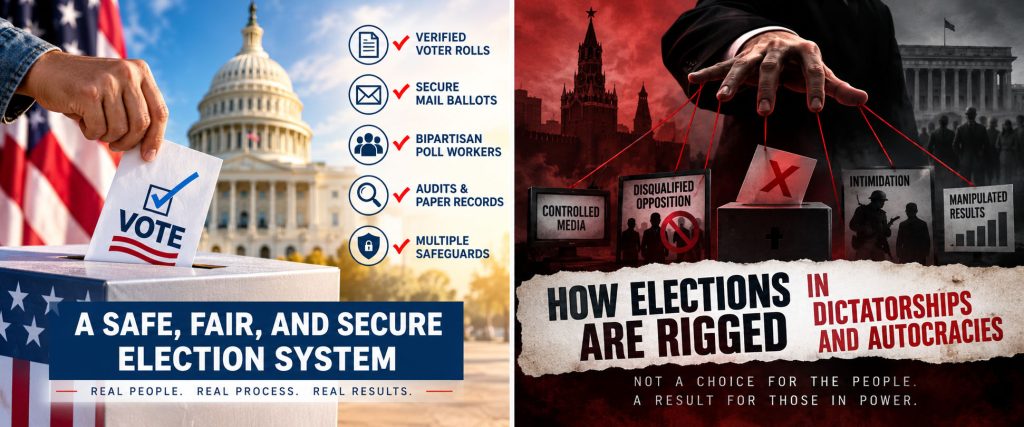
To appreciate the difference between legitimate election-security concerns and systematic election manipulation, consider how elections operate in authoritarian countries.
In genuinely manipulated elections, the problem is often not a handful of unlawful ballots.
The problem is that those in power control the conditions under which citizens are allowed to vote.
Consider Russia.
Independent political opposition faces severe restrictions. Opposition figures have been imprisoned or excluded, independent media have been suppressed, and meaningful political competition has been sharply constrained.
Russia holds elections, but the existence of ballots and polling places does not establish that citizens have a genuine opportunity to replace their government.
Or consider Venezuela.
The country’s disputed 2024 presidential election prompted international concern over the lack of transparent, verifiable results and restrictions on opposition participation. The government-controlled electoral authority declared Nicolás Maduro the winner, while opposition representatives presented tally records supporting a different outcome.
The essential issue was not whether an isolated individual voted improperly.
It was whether the government permitted a genuinely competitive election and an independently verifiable count.
That is the fundamental distinction.
In a functioning democracy, the voters choose their leaders. In an authoritarian system, those in power can manipulate the process to preserve their authority.
American elections have significant protections against such manipulation. Election administration is decentralized among states and local jurisdictions. Courts can review disputes. Candidates can challenge results through established legal procedures. Independent observers and journalists scrutinize the process. Paper records permit recounts and audits.
These protections are not perfect, nor are they self-sustaining.
But they are precisely the safeguards that distinguish a constitutional democracy from an authoritarian regime.
Election Integrity and Voting Rights Are Not Opposing Goals
There is nothing wrong with wanting secure elections.
Indeed, every American should want accurate voter rolls, reliable voting equipment, meaningful audits, enforcement of election laws, and consequences for anyone who knowingly commits election fraud.
Those are legitimate goals regardless of political affiliation.
But election integrity also requires protecting the rights of eligible voters.
A system that prevents unlawful votes but unnecessarily excludes lawful voters has not achieved the proper balance.
Likewise, a system that allows eligible citizens to vote but fails to safeguard the count would be unacceptable.
Election security and voter access should reinforce one another—not become competing partisan objectives.
The public should insist that claims of widespread fraud be supported by credible evidence. Officials should correct errors when they occur, investigate suspected misconduct, and explain their findings transparently.
What we should not do is confuse suspicion with proof or political disappointment with election fraud.
The Greatest Protection for Democracy Is an Informed Electorate
Americans have every right to question their government.
They have every right to demand transparency, challenge election procedures, seek recounts when warranted, and hold public officials accountable.
But there is an enormous difference between questioning an election based on evidence and declaring an election illegitimate because the result is politically inconvenient.
Our elections are administered by thousands of election officials, supported by countless poll workers, and subject to layers of legal and procedural oversight.
They deserve scrutiny. They also deserve fairness.
When an allegation of fraud is made, we should ask whether it has been substantiated, whether the number of incidents is significant, and whether there is credible evidence that the alleged wrongdoing affected the result.
We should apply those standards regardless of which party wins.
Because the legitimacy of our elections cannot depend on whether we like the outcome.
The Bottom Line: Don’t Let Fear Replace Facts
America’s election system is not flawless. No election system is.
But the available evidence does not support the sweeping allegation that American elections are systematically rigged by undocumented immigrants, deceased voters, or massive numbers of fraudulent mail ballots.
The evidence instead describes a system in which unlawful voting is uncommon, election officials use extensive safeguards, and errors and misconduct can be investigated through established procedures.
We should continue improving that system.
We should demand accountability from election officials and political leaders alike.
And we should be especially skeptical of anyone who insists that our elections are corrupt without providing credible evidence to support that extraordinary accusation.
Democracy requires more than the right to vote. It requires the willingness to protect that right, respect the lawful votes of others, and accept that the people—not those holding political office—decide who governs.
The American people should never be frightened away from exercising their right to vote.
Our elections belong to the voters.
And keeping them free, fair, accessible, and secure is a responsibility we all share.