
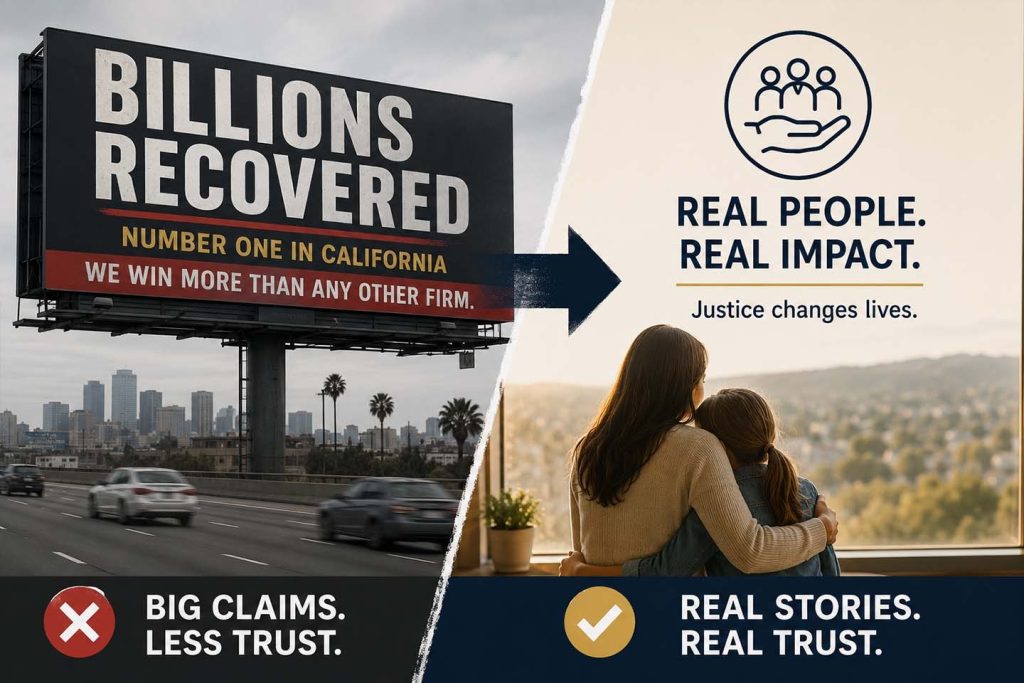
When “Billions Recovered” Becomes a Misleading Message
Drive down almost any freeway in California and you’ll see it: a billboard the size of a building, a lawyer’s face twenty feet tall, and a number so large it stops being a number and starts being a slogan. BILLIONS RECOVERED. NUMBER ONE IN CALIFORNIA. WE’VE WON MORE THAN ANY OTHER FIRM.
These ads are everywhere because they work. They also, in a lot of cases, mislead the very public they claim to serve — and they quietly poison the jury pool that personal injury lawyers depend on to do their jobs.
It’s time the profession had an honest conversation about that.
The Problem With "Technically True"
Here’s the trick with aggregate recovery numbers: they can be completely accurate and still completely misleading at the same time.
A firm might combine every settlement and verdict from every lawyer who has ever worked there, over twenty or thirty years, across hundreds of cases that had nothing to do with the person watching the ad. Add five attorneys’ individual “combined experience,” and thirty years of practice becomes a hundred and fifty. Cite one outlier verdict — the kind that happens once in a career — without mentioning it’s an outlier. None of it is technically a lie. All of it is designed to leave a false impression.
That’s the exact gap California lawmakers set out to close with Senate Bill 37.
SB 37: California Draws a Harder Line
SB 37, signed by Governor Newsom in October 2025 and effective January 1, 2026, amends California Business and Professions Code section 6157.2 and related provisions governing attorney advertising. It expands the definition of “advertisement” to cover nearly any communication meant to encourage someone to hire a lawyer — not just billboards and TV spots, but websites, landing pages, and lead-generation funnels.
The core of the bill is simple, and it’s aimed directly at the “billions recovered” style of marketing: an advertisement cannot contain misleading, deceptive, or false statements about a lawyer’s or firm’s skill, experience, reputation, or record — even if every individual fact in the ad is true. Characterizations of results have to be objectively verifiable. Guarantees or warranties about outcomes remain flatly prohibited. Claims of awards or recognition can’t be used if the award was purchased or based on nothing more than paying dues to join an organization.
And critically, SB 37 gives consumers a private right of action. A firm that keeps running a misleading ad after the law takes effect isn’t just risking a State Bar complaint anymore — it can be sued directly, with statutory damages reported in the range of $5,000 to $100,000 per violation.
This builds on obligations that already existed under the California Rules of Professional Conduct, which have long prohibited false or misleading communications about a lawyer’s services. SB 37 doesn’t invent the ethical standard. It gives it teeth.
Why This Matters Beyond the Ad Itself
The people who see “billions recovered” on a billboard aren’t just potential clients. Some of them are potential jurors.
Personal injury cases are decided by people who drive the same freeways, sit in the same waiting rooms, and absorb the same advertising as everyone else. When the public is repeatedly told — explicitly or by implication — that personal injury lawyers are running a jackpot machine, that lottery-sized recoveries are normal, and that firms compete on who’s won the most money rather than who’s helped the most people, it shapes how jurors walk into a courtroom before a single witness is sworn in.
Inflated advertising doesn’t just risk misleading an injured person choosing a lawyer. It cultivates a general skepticism toward the civil justice system itself — the sense that verdicts are inflated, that “runaway juries” are common, and that plaintiffs’ lawyers are more interested in headline numbers than in their clients. That skepticism becomes a headwind in every single case a firm tries, whether or not that firm was the one that put up the billboard. The whole profession absorbs the reputational cost of a few outsized claims.
That’s part of why this isn’t only a compliance issue. It’s a shared-fate issue for anyone who represents injured people.
A Better Story to Tell
Here’s the thing: personal injury lawyers actually have a good story to tell. It’s just not the one on the billboard.
It’s the client who could finally afford the surgery that let them walk their daughter down the aisle. It’s the single mother who kept her house because a settlement covered eighteen months of lost wages. It’s the family that got answers about what actually happened to someone they lost, not just a check.
Those stories are true. They’re specific. They’re verifiable. And they do something a nine-figure aggregate number never will: they show the public what personal injury law is actually for. Not billions. People.
Advertising built around real outcomes for real clients — with appropriate context, without cherry-picking, without combining five lawyers’ careers into one impossible statistic — accomplishes everything the billboard was trying to do. It builds trust. It generates calls. It sets realistic expectations, which means fewer disappointed clients and fewer bar complaints. And it does all of that without asking a future juror to quietly discount the next injured person who takes the stand.
The Bottom Line
SB 37 is a compliance deadline, but it’s also an opportunity. Firms that get ahead of it — that swap the “billions recovered” billboard for a wall of client stories — aren’t just avoiding a lawsuit. They’re doing right by an entire system that depends on public trust to function: their future clients, their profession, and the jurors who will eventually decide whether their next client gets justice.
The firms that figure that out first won’t just be compliant. They’ll be believed.

Well done Eric!
Love your perspective as always Eric! Keep up the great work and accountability! Much respect!